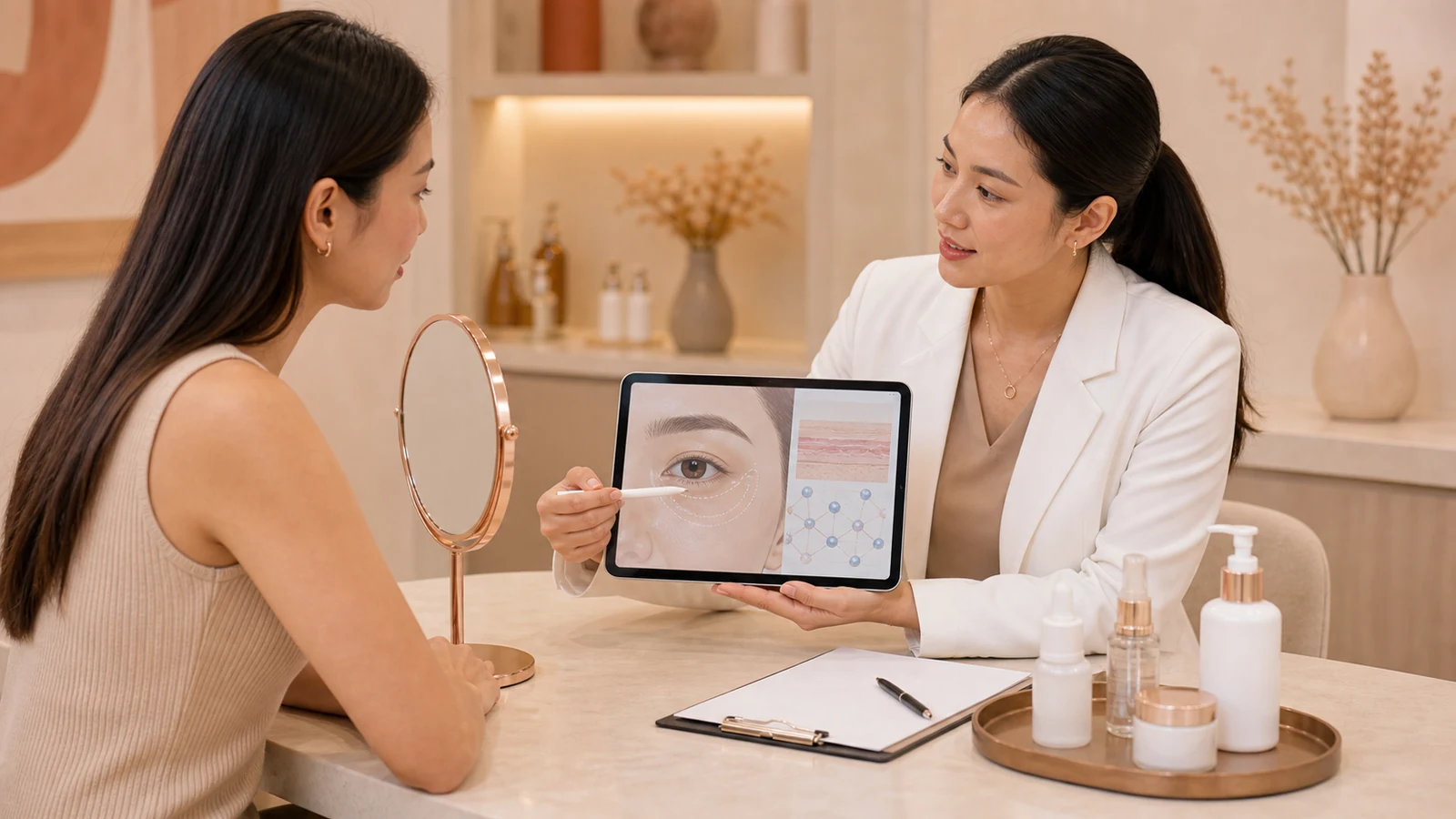
Plinest vs Skin Boosters and Fillers: a truth-first Affiner guide for Zamboanga patients with evidence, safety questions, FAQs, and consultation notes.


Introduction
Walk into any aesthetic clinic today and you’ll hear three words tossed around almost interchangeably: fillers, boosters, and Plinest. Patients often assume they’re variations of the same idea — different brands doing the same job. They’re not. And confusing them is the fastest way to book the wrong treatment for the wrong problem.
Three Different Jobs, Not Three Versions of One Job
- Dermal fillers are structural. Made mostly of hyaluronic acid gel, they’re injected to physically fill space — plumping hollow cheeks, softening a deep nasolabial fold, sharpening a jawline, restoring lost lip volume. The effect is immediate and mechanical: you’re adding material where volume has disappeared.
- Skin boosters work differently. Thinner, more fluid formulations of hyaluronic acid are placed just under the skin’s surface, not to add shape but to draw in water. The result is a hydration effect — smoother texture, a healthier glow — without changing the contour of the face.
- Plinest belongs to a third category entirely: polynucleotides. These are purified DNA fragments (typically derived from salmon or trout) that don’t fill or hydrate so much as signal — they nudge fibroblasts, the cells responsible for producing collagen and elastin, into repair mode. Nothing is being added to the tissue in a volumizing sense. Instead, the skin is being prompted to rebuild itself from within.

Why This Distinction Actually Matters
The mistake patients make most often is picking a treatment based on what a friend had, rather than what their own skin needs. Someone with hollowed under-eyes from genuine volume loss will be disappointed by a polynucleotide treatment, because Plinest was never designed to lift or fill. Conversely, someone whose real issue is thin, crepey, tired-looking skin — with no meaningful volume deficit — may find that filler adds bulk without solving the underlying textural problem.
A useful mental shortcut: fillers shape, boosters hydrate, Plinest repairs. They answer different questions. “Where is volume missing?” is a filler question. “Why does my skin look dry and dull?” is a booster question. “Why does my skin feel thin, fragile, or slow to bounce back?” is a Plinest question.
Timelines Differ, Too
Filler results are visible the moment you leave the clinic. Skin boosters bring a gradual glow within days to a couple of weeks. Plinest is the slowest of the three — because it’s not adding anything, it’s initiating a biological process. Most patients need a short course of sessions spaced weeks apart, with results building gradually over one to two months and continuing to improve afterward.
They’re Often Complementary, Not Competing
Increasingly, practitioners don’t treat these as either/or choices. A common approach layers polynucleotides to improve the underlying quality of the skin, then uses filler afterward to address genuine structural volume loss — building on healthier tissue rather than masking tired skin with added volume.
The Real Takeaway
The question isn’t “which treatment is best.” It’s “what is actually wrong with my skin?” Volume loss, dehydration, and diminished skin quality are three separate problems, and each has a purpose-built solution. A good consultation — not a trending product name — should be what determines your treatment plan. Any practitioner worth seeing will assess your specific concern before recommending a needle at all.
FAQ
Is Plinest a type of dermal filler?
No. Plinest is a polynucleotide biostimulator. It doesn’t add volume the way hyaluronic acid fillers do — it works at a cellular level to encourage your skin to produce its own collagen and elastin.
Is Plinest the same as a skin booster?
Not quite, though they’re often grouped together. Traditional skin boosters are hyaluronic acid–based and work mainly by drawing water into the skin for hydration. Plinest uses DNA-derived polynucleotides to stimulate repair and regeneration rather than simply hydrating.
Which treatment works fastest?
Fillers give an immediate result. Skin boosters show a hydration glow within days to a couple of weeks. Plinest is the slowest to show change, since it relies on triggering a biological repair process rather than adding material directly.
Can I combine Plinest with fillers or skin boosters?
Yes, and many practitioners do. A common approach is to improve skin quality with Plinest first, then address any genuine volume loss with filler, so the filler is being placed into healthier tissue.
Who is a good candidate for Plinest?
Patients with thin, crepey, dull, or tired-looking skin — particularly in delicate areas like under the eyes, neck, or décolletage — where the concern is skin quality rather than lost volume.
Who should choose a filler instead?
Anyone with visible volume loss: hollowed cheeks, a flattened jawline, thinning lips, or deep static folds that persist even at rest. Filler physically restores that missing structure.
How many Plinest sessions will I need?
Most patients start with a short course of sessions spaced a few weeks apart, with results building gradually and continuing to improve after the course ends. Your practitioner can tailor this to your skin’s condition.
Is Plinest safe?
Plinest uses highly purified, sterilized polynucleotides with a well-established safety profile, but as with any injectable, it should only be administered by a qualified, experienced medical practitioner after a proper consultation.
Sources
- PubMed – Real-life assessment of injectable PN HPT including Plinest
- PubMed – Expert perspectives on polynucleotides in aesthetic medicine
- PubMed – Polynucleotide injections for periorbital rhytides
- Affiner Aesthetic Clinic – Contact
Schedule Appointment
If this treatment sounds relevant to your concern, schedule a consultation with Affiner Aesthetic Clinic. Bring your goals, medical history, recent treatments, and current skincare list so the team can decide what is appropriate for you. Schedule Appointment.